
Free Catherine Deng!
What the most baffling DQ at 2022 Nationals tells us about NCAA officiating and the need for safeguards against human error.

Part 1. The Infraction: ‘Delay initiating turn after past vertical - back’
On March 16, 2022, at the NCAA Division III National Championships in Indianapolis, Caltech First-Year Catherine Deng finished her 200 IM prelims in 2:08.49, a school record.
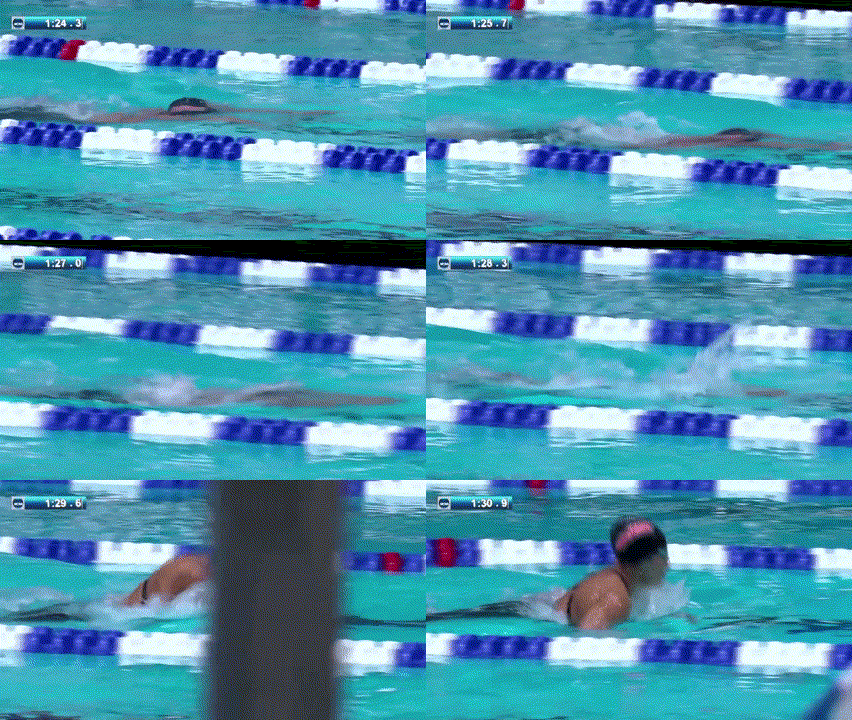
But…on the final turn of the event, in the freestyle leg, the Turn Judge - standing on the bulkhead - had held an open hand high in the air to signal an infraction on Ms. Deng.

It is not obvious why an infraction was signaled. Ms. Deng’s turn violated no rule.
Unexpected movements
That said, Ms. Deng had made an unexpected movement. The gif above shows a right arm pull, left arm pull, and then this odd motion where Ms. Deng looks like she is going to do one more right arm pull, raising her right shoulder out of the water, then decides against it. She twists back into a flat position on her stomach and glides into her flip-turn.
It looks funny. But - practically speaking - there are no rules around freestyle turns1, so no rule was violated. But it sure looks like the Turn Judge saw something unexpected (if irrelevant), and up went the hand.
Of course, that does not explain how this violation got written-up as a backstroke-turn violation.
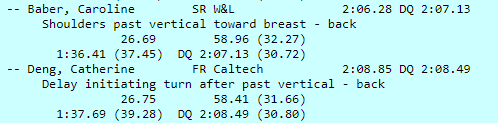
Ms. Deng was DQ’d for ‘gliding’ on the backstroke turn
The infraction write-up states that Ms. Deng’s infraction took place on her backstroke turn. ‘Delay initiating turn after past vertical - back’ is the code used when a swimmer, on the backstroke, turns to their front and then glides excessively before initiating their flip-turn. But in this case, the infraction signal came on the freestyle turn, where (again) there is no such rule against gliding (or shimmying or feinting a right-arm pull or whatever Ms. Deng may have done).
And there was no infraction signalled during Ms. Deng’s backstroke turn. More on that in a moment.
We cannot know what happened in the Turn Judge’s head, we cannot know what the Turn Judge said in reporting the infraction to the head official, and we do not know how the head official handled that information. All we know is that, in the meet report, the reason given for Ms. Deng’s disqualification is ‘Delay initiating turn after past vertical - back’.
Remember, when an infraction is signaled matters. The rules of officiating for the NCAA are clear on this:
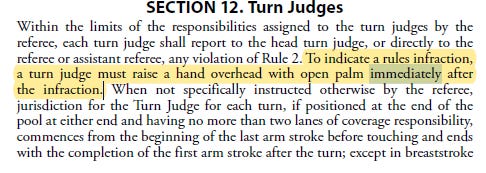
The judge must - not should, not really ought to, but must - raise their hand overhead immediately - not at some point in the same event, but immediately - after seeing an infraction. The wording of this rule for officials seems strong and clear (it is actually not strong enough, and we will return to that a little later on).
You can watch the backstroke turn from two angles in the gif below. Clearly, the Turn Judge did not signal any infraction on the backstroke turn.
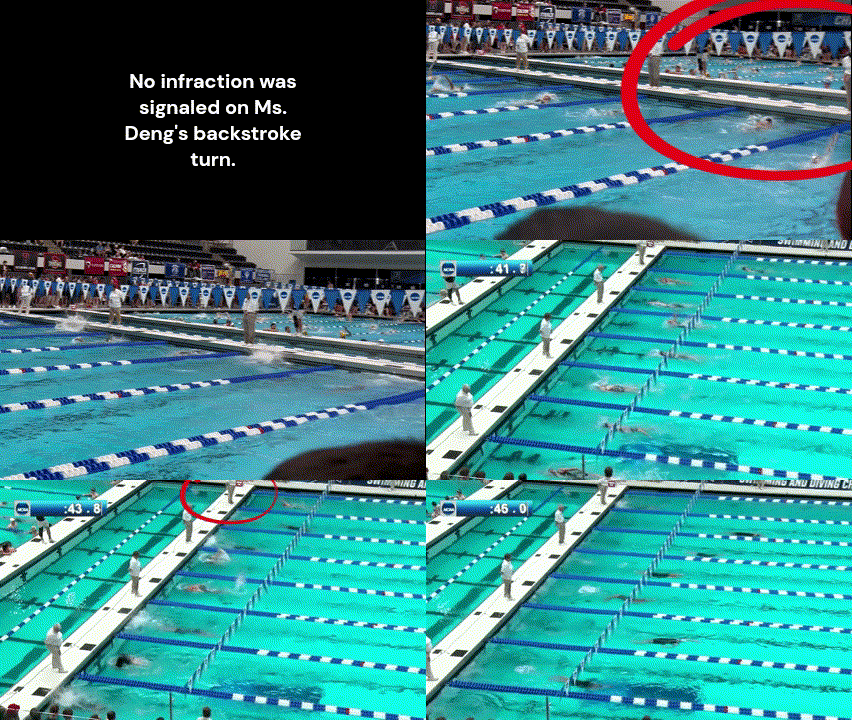
For good reason. Here is Ms. Deng’s backstroke turn compared with a backstroke turn from a training film for officials, showing how a proper backstroke turn should look.

Though both Ms. Deng and the training-film swimmer turned over at the same time, Ms. Deng was closer to the wall and spent (marginally) less time gliding than the swimmer in the training film.
Ms. Deng’s backstroke turn wasn’t just legal, it was training-film quality.
Of course, you could say that is a judgment call.
Part 2. The Appeal: judgment calls
Whether or not Catherine Deng violated Rule 2, Section 2, Article 1.c of the NCAA rules - whether she turned over with a continuous pull of her (in this case, left) arm, and then initiated a turn without significant delay or gliding or extra kicking - is a judgment call.
Obviously, when you look at it, Ms. Deng did not violate that rule - the video could not be clearer on this point - but that might not be what matters most. There were procedural problems, and none of them were judgment calls:
An infraction was not signaled on the backstroke turn.
An infraction was signaled on the freestyle turn.
An infraction was not reported on freestyle turn.
An infraction was reported on the backstroke turn.
Why does it matter if the infraction was, or was not, properly reported and recorded?
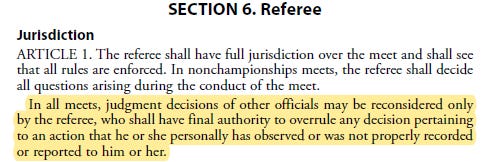
When an infraction is not properly reported and recorded - and keep in mind proper reporting of an infraction means that a Turn Judge must immediately raise a hand overhead upon seeing an infraction - that (explicitly) is grounds for overturning a disqualification. The judgment call on the legality of the turn itself is irrelevant.
The flaw in this rule is that it gives the top meet officials too much leeway to fail to enforce procedure. It is the difference between can and must. If a referee can overturn a decision that is not properly recorded or reported, that implies that the referee might also choose not to.
Effective rules state remedies.
Here is an example of an effective version of this rule from a not-so-distant organization:
“…the Referee, Stroke, Turn, or Relay Take-off Judge upon observing an infraction, shall immediately raise one hand overhead. If the official does not do so, there shall be no disqualification...” - 2023 USA Swimming Rules and Regulations, 102.21
In other words: do it right or don’t do it at all. By stating a remedy in the rule, USA Swimming makes it clear that you cannot disqualify a swimmer if you do not follow proper procedure. The NCAA has no such requirement.
USA Swimming makes it clear that you cannot disqualify a swimmer if you do not follow proper procedure. The NCAA has no such requirement.
The NCAA, by choosing to word the rule differently from USA Swimming, created a rule that isn’t really a rule, meaning a rule that can be violated - by officials - without consequence (for officials).
The Caltech coaches could immediately see that something was wrong with the disqualification, even if it took several minutes for them to learn that Ms. Deng was being disqualified for a backstroke-turn infraction.
It took several minutes for them to learn this because the head official - to whom they were speaking on the deck - never acknowledged that the supposed infraction did not come on the same turn as the infraction signal. The Caltech coaches were also not able to speak to the official who made the call.
The limits of the appeal process
Here is where NCAA Rule 8, Section 4, Article 3 (Appeal Procedure) becomes relevant, especially this part:
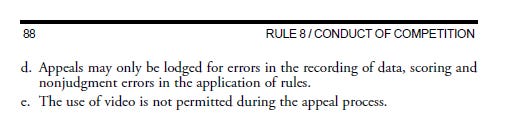
Article 3.d identifies this concept of ‘judgment calls’ - a broad area of rule application where there can be no appeal based on whether or not the official made the right decision about a rule violation.2
As for Article 3.e the Caltech coaches, of course, had video. Lots of directly relevant video. We all did. It was on the NCAA broadcast. Unlike a USA Swimming event, however, that video could not be used in the appeal.3
That did not prevent the Caltech coaches from immediately appealing the DQ. For about 3 minutes the Caltech coaches protested on the deck, vigorously, but to no avail, leading the broadcast announcer to deadpan:
‘And it’s apparent there was no agreement on the DQ in that heat…’
Caltech then filed an appeal to the Meet Committee, also to no avail. Not only was the disqualification not overturned, but Caltech never even received acknowledgment that there were any irregularities in officiating procedure…even though the irregularities in officiating procedure were obvious to anyone who looked.
And at every step Caltech coaches were told there was no remedy: it was a ‘judgment call’, so there was no basis for an appeal.
How was this a judgment call?
But how was this a judgment call? It was not a judgment call whether the Turn Judge followed proper procedure for signalling an infraction. Clearly, the Turn Judge did not.
And Article 3.d is clear about what is not a judgment call: ‘errors in the application of rules’ are not judgment calls. Isn’t it an ‘error in the application of rules’ to apply backstroke-turn rules to a freestyle turn?
Isn’t it an ‘error in the application of rules’ to apply backstroke-turn rules to a freestyle turn?
The Caltech coaches raised these questions and concerns at each stage. At each stage, their appeal was rejected and they were told, basically, ‘nah, sounds like a judgment call.’
Because apparently whether or not something is a judgment call is…a judgment call. And judgment calls, including judgment calls about whether or not something is a judgment call, are not subject to appeal.
Part 3. The Outcome: the process is the problem.
In many NCAA sports, video replay is used to improve the overall quality of officiating. In USA Swimming events, video replay is used to improve the overall quality of officiating. But not in NCAA Swimming and Diving.4
Use of video in appeals is, of course, just one safeguard against human error. And while there are currently other safeguards in place in NCAA Swimming and Diving, the example of what happened to Catherine Deng highlights the inadequacy of those safeguards.
Take for example the safeguard of officials checking each others work.
Referees
Referees have broad discretion to overturn decisions about potential infractions they themselves observed. While Referees can’t watch everything all the time, if a Referee has reason to believe that a given official is distressed, fatigued, or struggling, the Referee could pay closer attention to the decisions of that official.
But look what happened here. The inexplicable disqualification of Ms. Deng came in the 4th event on the first day of the meet. Surely, the Turn Judge was not fatigued. In fact, nothing else in her conduct made her appear distressed or disoriented. There was no obvious reason why a Referee would give that Turn Judge extra scrutiny.
Visual confirmation
And apparently nothing that happened after the infraction-signal raised concern among any other official. For instance, it appears that no official noticed that the Turn Judge signaled an infraction on the freestyle-turn that was then reported as an infraction on the backstroke-turn.
It matters when a Turn Judge raises a hand because other officials are supposed to notice it. That’s the point. Yet it appears no other official noticed the discrepancy between when the infraction was signaled and where in the race the infraction was said to take place.
Reporting
The Turn Judge just appears to have momentarily lost touch with the situation, and applied backstroke-turn rules to an unorthodox freestyle-turn. The Turn Judge’s report, if accurate, would have sounded like nonsense to the other officials. ‘Delay initiating turn after past vertical - free’ or ‘Whoa, what was that - free’ are not permissible DQ codes because they are not violations.
Yet somehow - in the reporting - what would have been a nonsense report of a non-violation got recategorized into a specific violation of an actual rule, a violation of a rule that was not signaled and that did not take place.
Where things get dark
This is where this story threatens to get most unpleasant. We don’t think any of the officials in this process are bad people, but poorly designed systems encourage disappointing behavior. And because the NCAA decision-making process around disqualifications and appeals is like a black box, we just don’t know what happened. The interactions between officials and what was said (and when it was said) is shielded from view.
For example, we do not know what the Turn Judge reported to the other officials and how that related to what was signaled on-deck. We do not know if other officials altered the report they received, and changed it so it would be less nonsensical (if no more accurate). If there was some other complexity at play that would clear up the mystery - something random, not self-protective or intentional - we would not know. The NCAA appeals process keeps us in the dark.
And the process is the problem
We want to be clear that we are not picking on this one Turn Judge. Yes, that Turn Judge made a colossally bad call. But, we don’t think the Turn Judge’s error is so atypical (more below) and we also wonder: what about all the other officials who should have said or done…something? If everyone is failing, if inaccurate information is passed along, and the process protects there errors and prevents correction, then the process - not the people - is the problem.
We think the Turn Judge’s error is an extreme example of a normal kind of mistake. People lose track of things all the time. People have automatic - though not always appropriate - reactions to unexpected movements, noises, sensations, etc. And as the saying goes ‘only a fool trusts his own memory.’ These are just some of the obvious ways we - systematically - get things wrong.
The less extreme examples of human error in officiating might actually be more of a problem, either because they are more common or because they are harder to detect. And, without better procedures (including permitting video during appeals), even obvious errors will go undetected and uncorrected.
Error and choice
With NCAA swim meets, the reforms that would safeguard against further egregious human officiating error are not exotic, untested, or hard to understand. They are simply the rules used by USA Swimming. Like, if the official does not immediately signal the infraction, then there is no DQ. And ‘judgment calls’ aren’t sacred - they can be reviewed during an appeal. And if video helps the officials get the call right, then use the video.
Human error (in officiating swim meets, or anything else) is predictable and inevitable, but refusing to institute safeguards against human error is a choice. The NCAA is making the wrong choice here, and it is harming the athletes the NCAA claims to serve.
A note on Catherine Deng
There is a lot to admire about Catherine Deng.
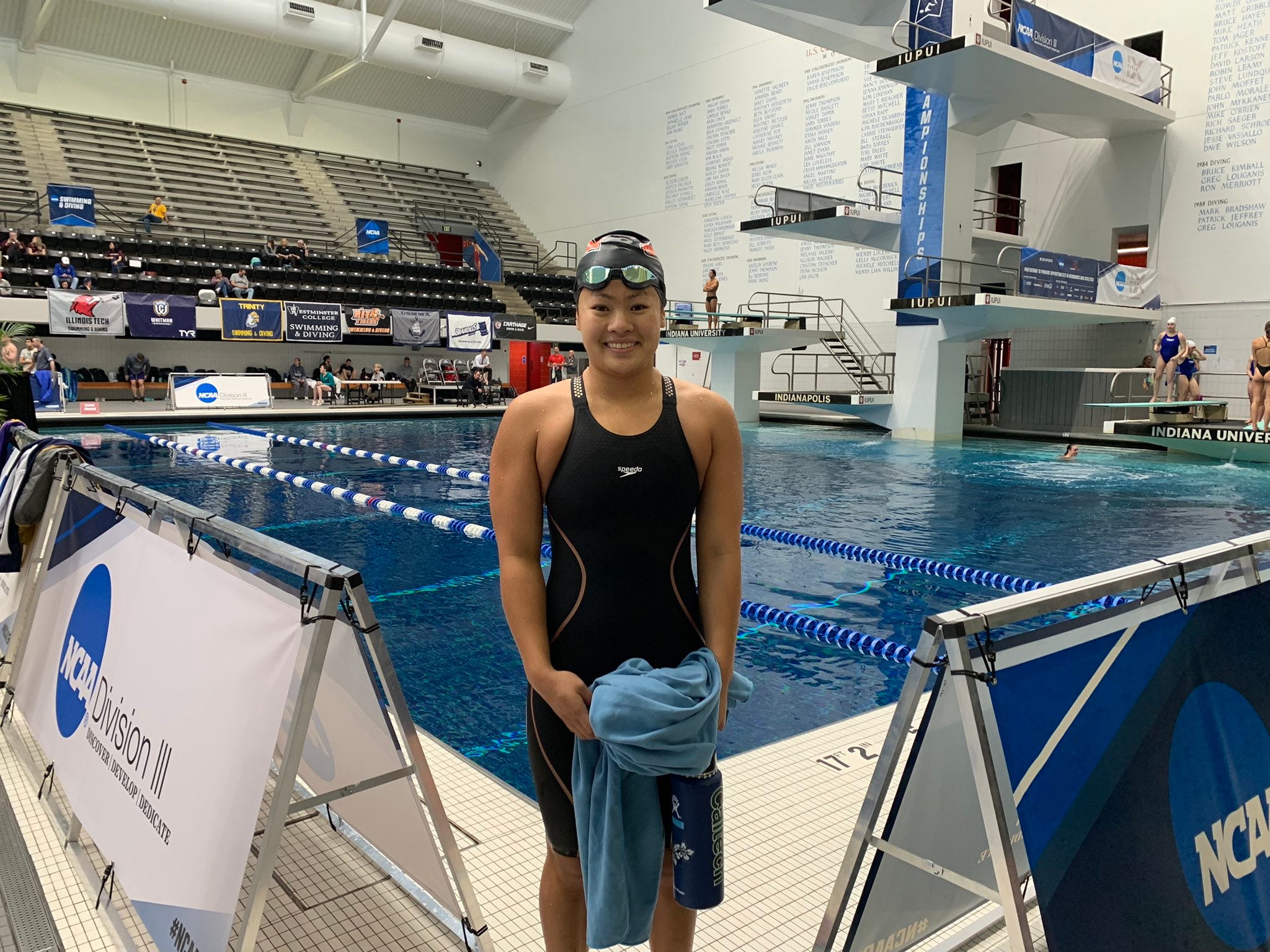
First, she got into Caltech, which is preposterously difficult. There Ms. Deng kept swimming while handling that course-load, and actually improved as an athlete (tip of the hat to the Caltech coaching staff as well).
At 2022 Nationals, she recovered from that outrageously unfair officiating call, and then swam her next event - 100 Fly - fast enough to make the A Final. In the process she became the first swimmer in the history of Caltech’s Women’s program to be named an All-American.
And Caltech credits Ms. Deng with the school record in 200 IM based on her 2:08.49 swim. A phantom DQ won’t be permitted to undo what Ms. Deng accomplished.
Since last Summer, Ms. Deng has been sidelined by injury, but she is likely to return to swimming next season. We expect to see her back at Nationals in the coming years.
But her summertime injury is also a reminder. The opportunities are few for these extraordinary athletes to compete at the highest level. Their period of eligibility is severely limited. And (like all of us) their health and ability to perform is fragile.
So when it comes to disqualifying an athlete who has invested so much of their life and labor into achieving their own highest-possible level of excellence in events that are intrinsically difficult and demanding, maybe we should be doing everything we can to get these calls right.
There are of course some rules around freestyle turns, like you cannot use the lane-ropes or push off from the bottom of the pool or totally miss the wall, but really that is about it.
Except in IM where we have the ‘Lochte Rule’ but that is not relevant in Ms. Deng’s case.
If the Turn Judge believed there had been a violation of the Lochte Rule, that was never indicated at any point in this process. Plus, look at the gif. The Turn Judge’s hand is going up before Ms. Deng’s feet hit the wall. There’s no way to violate the Lochte Rule until after you have pushed-off from the wall.
The stroke for each one-fourth of the designated distance shall follow the prescribed rules for that stroke, except in the freestyle, the swimmer must be on the breast except when executing a turn.”
Intermediate turns within each stroke shall conform to the turn rules for that stroke, except that in the freestyle turn, the swimmer must return to the breast before any kick or stroke.”, after your flipturn, you have to rotate to your front before kicking.
While coaches are not permitted to appeal judgment calls, Referees are free to overturn judgment calls if they so choose.
The NCAA rules afford special status to judgment calls only when the call is disputed by a coach or swimmer.
USA Swimming has broad rules allowing the use of video to provide safeguards against obvious mistakes in officiating.
102.21 DISQUALIFICATIONS
701.10 The Referee shall have the authority to use any video or electronic or mechanical judging devices in judging the finish order or in making other rulings
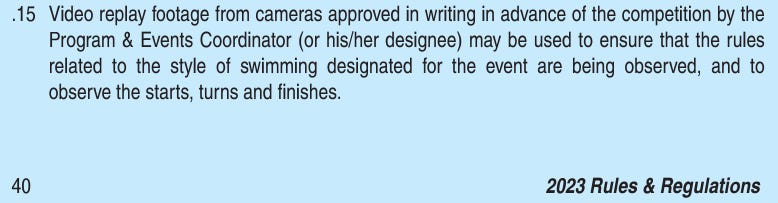
The statements above seem to just be saying that video is permissible in appeals. But note how the wording has changed from last year.
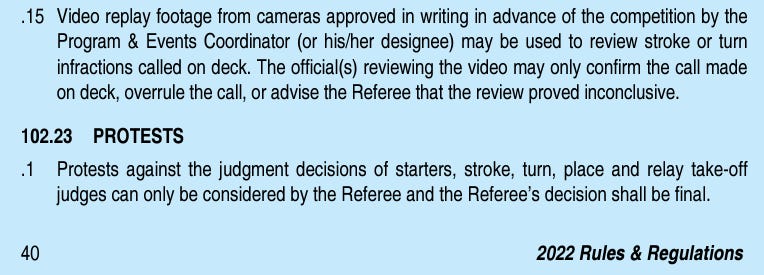
Gone is the clear prohibition on initiating new disqualifications through video review. Now the rules simply say that video can be used by officials to ensure the rules are followed. Full stop.
NCAA Swimming and Diving doesn’t have anything against the use of video during swim meets. They allow use of video to review violations of the 15 meter rule, and have broad rules allowing for the use of video by officials to monitor other electronic equipment - like take-off sensors on the blocks used during relays.
There seems to be - in NCAA Swimming and Diving rules - a real sensitivity to the fallibility of electronic relay judging systems. There seems to be no corresponding sensitivity to the far more common problem of human fallibility.
NCAA - when can you use video
to review an official’s call on a 15m violation (any event) (p. 39)
to review relay disqualifications (leaving early), and determine if electronic sensing equipment malfunctioned (p. 42)
You find on page 42 of the NCAA swimming rules an extensive description of how to use video to review electronic relay takeoff equipment.